As part of my master plan to bring all my websites together under one roof, this blog-based website now has the address of RobMacKillop.net – it is not case sensitive, so robmackillop.net will also work. Note that www. is not needed, but no harm will be done if you add it. Feel free to add it to your Favorites, as it will now be my main site, eventually replacing the others.
I will be returning to the lute this year, with a 13-course baroque lute on order with Malcolm Prior, and a 7c lute from Eric Stefanelli. Expect the ‘Lute’ page on this site to grow and grow.
I also have a number of books and CDs being released for banjo and also ukulele. Watch this space.
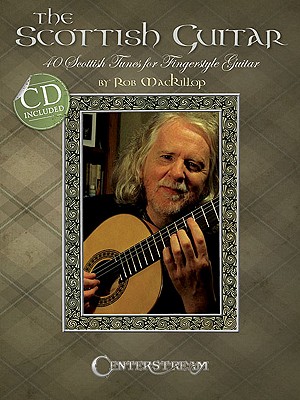
My book, The Scottish Guitar – 40 Scottish Tunes For Fingerstyle Guitar has just been published by Centerstream with distribution globally by Hal Leonard. Read more at the Hal Leonard website. It is available from the usual outlets.
The book has 40 arrangements for DADGAD, Open D and Open G tunings, as well as 40 sound files of my performances. For example, here are two contrasting pieces,
and
As the publicity says:
The Scottish Guitar
40 Scottish Tunes for Fingerstyle Guitar
Series: Guitar
Format: Softcover with CD – TAB
Author: Rob MacKillop
Rob MacKillop is regarded as one of Scotland’s finest musicians. In this groundbreaking book, he defines a uniquely Scottish way of playing the guitar, incorporating rich traditions into later material – from Gaelic songs to traditional airs and dances. His arrangements reflect the origins of the tunes, with appropriate ornaments and phrasing. The accompanying CD helps players gain a deeper understanding of the subtle art of phrasing. Tunings used are DADGAD, Open D and Open G.
I have a growing interest in the Plectrum Guitar, which is often associated with jazz but in fact has a much wider repertoire and practice. One could fancifully trace it back to the vihuela penola of 16th-century Spain, or ‘Latin’ and Moorish guitars of the medieval period, but for most people the work of Eddie Lang would be a good starting place. This wonderful website http://www.eddielang.com/el_home.html provides an overview of his work.
When I started guitar, aged 14, alone in my bedroom, I had Ivor Mairants’ Book Of Daily Exercises and Mickey Baker’sJazz Guitar Volume 1 to keep me company. Sadly I made little headway with either book, but now aged 51 and looking back I recall my struggle to try to understand the instrument and its notation, and I find myself wishing to take another look, to try and reconnect with that kid in his room.
Just this last few days I have received a NEW GUITAR – always a BIG DAY 🙂 It is The Loar LH-700, a recreation of the early archtops made by Loyd Loar for Gibson. It is a magnificent guitar.
I also got hold of the following book from Mel Bay Publications, The Masters Of The Plectrum Guitar:
…which has a wealth of material in it, some items by Eddie Lang. I recorded the first two pieces in the book. The first uses the strings the guitar came with, regular acoustic-guitar strings. The second has flatwound (smoother) strings as I felt the regular strings were too bright.
I also have some old Plectrum Guitar tutor books, such as Ivor Mairants’ Guitar Tutor in Theory and Practice, and ordered from Abe Books, Play The Plectrum Guitar.
My teenage daughter’s generation do not use email, favouring instead communicating via Facebook and Windows Live, while Twitter is also favoured by many. Sharing ‘likes’ has become the new revolution in online usage, with each video, photo or article accompanied by half a dozen or more ‘share icons’. Suddenly my old website looks…well, old. It lacks interaction – the viewer needs to email me any comments, or copy a link to send to a friend. Far too much trouble. Now, all they need to do is click the little Facebook icon, and all their Facebook friends (sometimes hundreds) can view their recommendation.
With that in mind I have turned again to this wordpress blog, and have started thinking about its use and usefulness as a web page. Each blog entry or Page is accompanied by a number of sharing options, plus viewers can easily make comments, interacting with the author and also with anyone else who wishes to comment on the same thing. A dialogue ensues. As a web author, I like and wish to encourage this interaction. My musical activity is often project led, and exploratory, and as such I appreciate feedback and enquiry. I am learning as I go, and some people enjoy going on the journey with me, while some others feel they have knowledge I am lacking and wish to help by pointing me to different resources. All good use of the net.
The ‘Page’ element of this Blog can be very useful. I plan to include introductory information, with links to my other websites for greater depth. I’m not sure if I can easily include here all the info on my other sites – some 15 years of work – into this one site, but we shall see how things develop. It may be a case of having only this one site, with everything brought together and edited for the new online experience. We shall see…your comments, of course, most welcome…
This is a beautiful piece by one of America’s best banjo composers, Parke Hunter, 1876-1912. I’m recording wav/mp3 files of all the main pieces in Mel Bay’s Banjo Method, actually written by the late Frank Bradbury. This piece stood out as being very different to the others in the book. By the way, it is a fantastic book for learning to read standard notation on the banjo. My sight-reading ability has improved dramatically while working through the book. Eventually Mel Bay will host the files on their site.
I’ve been very remiss in completely forgetting my blog duties! I’ll try to be more active now, and try to figure out how to integrate with Facebook and Twitter.
More news to come – a very busy musical year ahead…
Two studies or preludes by Ponce, and La Negra by Lauro. Having trouble with the fourth string which has developed a zing. Can’t wait to get my new guitar, again a short-scale model by Rodriguez, but a big upgrade on what I have already. Negociating with them for a ten-string, which would be amazing.
LATER – I’ve now removed both videos. That D string was bugging me. Will do them again later…
I recall playing this piece many years ago, maybe 22 years ago, and don’t think I’ve played it since, certainly not in the last 10 or 15 years,yet somehow it was still in the memory banks. Some tunes just get you that way. I used it to demonstrate the Ambra string set by Aquila which is meant to be the nylgut version of their Gut and Silk set, specially created for guitars from the time of Tarrega to Pujol, about 1880 – 1950, and I think it does that admirably. The feel of gut or nylgut is great for a no-nail, flesh technique, and I hope you like the sound. I can’t believe it is a cheap student guitar, but I’m looking forward to the upgrade arriving from Rodriguez in three weeks or so time.
In an attempt to organise my YT pages, I’ve added three Playlists to the BalcarresGuy Channel – Lute, Baroque Guitar, and 19th-Century Guitar. How do you access these? Locate the Subscribe, Uploads and Playlists buttons above the main video – click Playlists. Choose which Playlist you want to view, then once you press Play on the first video, all the videos in that Playlist will play in order.
I’ve removed ‘Three Renaissance Spanish Pieces’ because it was out of tune. I was pushing the limits of the cheap beginners guitar that got me excited about playing classical guitar again. The prospect of playing 400 years of music on one instrument goes against the philosophy I’ve lived by for the last twenty years – the right instrument for the right music- yet I can see a way of retaining integrity through an aesthetic of historically-informed perfomance on a modern instrument. The technique I’ve developed through lute and baroque guitar plucking has allowed me to bring something new to the modern classical guitar. Fernando Sor used a similar technique, and he too knew he was swimming against the tide. It might not work for music by Koshkin or Ohana, but why does it have to? Lots of people playing that music already.
I plan to record quite a bit of lute and vihuela repertoire on the modern classical guitar, but to do that I need to upgrade the instrument. Manuel Rodriguez Jr is overseeing a 60cms guitar for me, with an ebony fingerboard (never liked rosewood) and a French polished top. Should arrive in a month. Manuel has been very impressed with the videos I made of the ‘Baby Rodriguez’ guitar, and is giving me a good deal on this new model. Looking forward to it. So I might hold back on recording new pieces until it arrives.

 Rob MacKillop ~ Musician