Here’s a free zither-banjo mini album of compositions by the king of the zither banjo, Alfred D. Cammeyer (1862 – 1949)
The zither banjo is similar to a regular 5-string classic banjo, but with a few significant changes:
1. The 1st, 2nd and 5th strings are plain steel; the 3rd is gut; the 4th is silk or nylon wound in silver
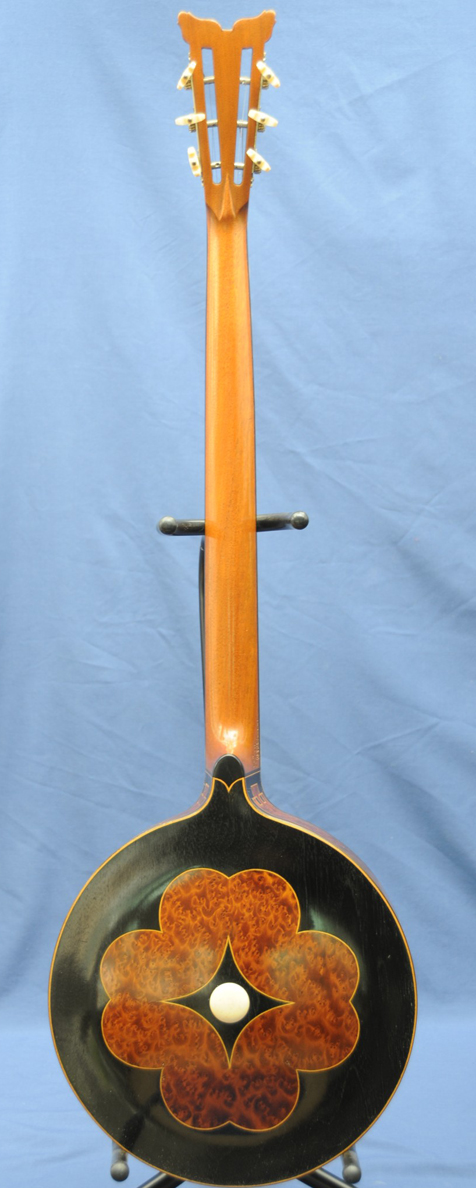
2. The back is entirely enclosed
3. The skin surface is quite small, 7 to 9 inches
4. There are six tuning machines. One is a dummy.
5. Note the absence of a 5th-string tuner. Instead, the string enters a tunnel at the fifth fret, emerging at the nut. Although this feature appears on some regular banjos, it is a common feature of zither banjos.
The instrument responds best to a softer right-hand technique than used on regular classic banjos. It is recommended by Cammeyer and others to use a ‘composite stroke’ of right-hand fingernail and flesh, however I use only flesh, as that is the way I play all my instruments.
The foremost composer for the instrument is Alfred D. Cammeyer, who claimed to have invented the instrument. His music can be very romantic, expressive, and sounds nothing like any other banjo music.
Almost a decade ago I had a zither banjo by Jack Abbott Snr., but soon sold – although a beautiful instrument, I couldn’t connect with it at all. You can see photos of it, and videos I did with it, below.
More recently I got another zither banjo, this time by the self-styled “Pioneer of the Zither Banjo”, W. Temlett Snr. This is a fine instrument, which I enjoy playing. I am currently exploring the music of Cammeyer, and will include videos here:
The zb illustrated below is the beautiful Jack Abbott Snr., Amboyna No.1 Zither Banjo

And some videos I did in the brief time I owned the instrument:
 Rob MacKillop ~ Musician
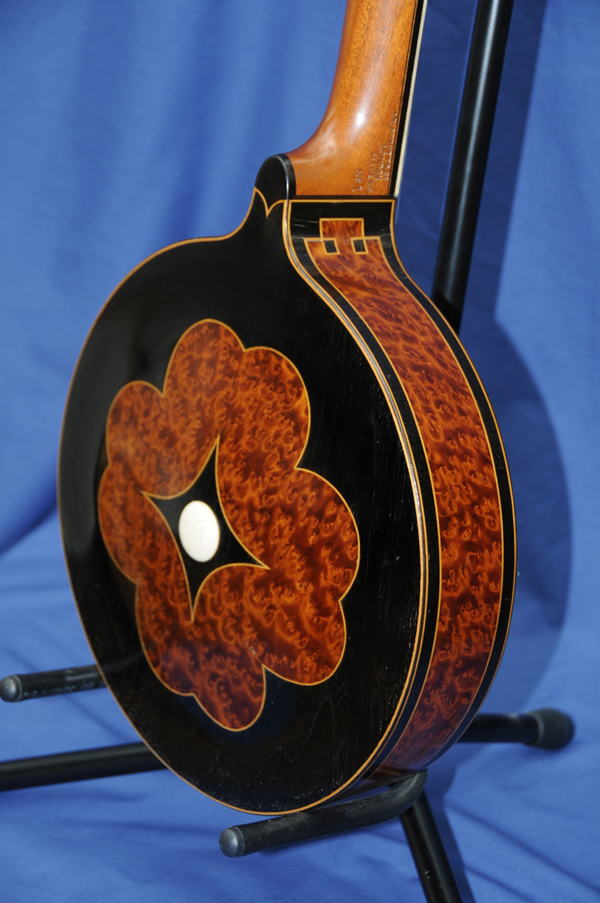

Rather like the mandoline-banjo, with the skin being tautened by a pair of separate smaller metal hoops within the outer body-come-resonator.
Hello..Im sorting some banjo books(old) and came across
The Alfred D. Crammeyer Banjoist..containing his most popular solos.Would this interest you..?
Craig Wood
Thanks, but no thanks, Craig. I have all Cammeyer’s works already. Thanks for the offer, though.
Having been a fan of yours, Rob, for many a long year, I’m delighted to have found this website, and of course extremely grateful to you for creating it.
I’ve been in love with the zither-banjo ever since obtaining my first one. a Barnes & Mullins Perfect No.2, from a cinema queue busker in Notting Hill for the princely sum of £2 10 shillings. I still have it (or rather my daughter has) and I’ve been through quite a few since, but there are still one or two things I don’t know, so I hope you don’t mind the odd question now and then.
My family and the zb go back a long way. Alfred Glanville Vance aka The Great Vance, the most famous Music Hall entertainer of his day (the 1850’s) is a distant relative and according to family legend played a zither-banjo. The story of Cammeyer inventing the instrument is totally rejected by the way among our lot, and it is claimed that the term was in common use around the time William Temlett took out his patent in 1869.
All the best. Thanks for reading this,
Black Jake.
Hi Jake. Good to hear from you. I love the title of “Perfect No.2” as if Perfect No.1 wasn’t perfect enough 🙂 Wow, you do have an important link with the past! That must keep you going. As for Temlett and the ZB, you are of course right. Cammeyer claimed he invented it. He might have tweaked it, and the Vibrante was a cut above the others, but he certainly can lay claim to helping to popularise it, though how many people could play his compositions is open to question. To bring order to this chaos, I recorded my Cammeyer EP on a Temlett ZB 🙂
Cheers,
Rob
Wow! What a delight to find your music this evening! I have been playing banjo for thirty years (American), and I have never before come across the zither banjo! Just wonderful! It’s an entirely different and lovely thing!
I always gravitate to the sweet sounding spot near the neck, to unusual chords and I prefer to play without picks. I let the notes sing slowly and prefer not to cut them off. I like nylon strings too! Tonight I am thinking that perhaps I am a zither banjo player at heart and didn’t know it until now!
Thanks for sharing!!
It sounds like you should get yourself a zither banjo! They are still very inexpensive in the UK. My Temlett was only about £250. Even with shipping to the US, that has to be a bargain. Best wishes finding one. You might also visit this site: https://classic-banjo.ning.com
Cheers,
Rob
Hi Rob, I am about to start restoration of a Zither Banjo and am struggling to find info regarding appropriate strings. Above you say they are a composite set of steel, gut (nylon) and wire wound nylon. I can only find sets of 5 all metal standard banjo strings. Do you know anywhere I can buy a composite set or if I need to purchase individual strings what material and gauges would you recommend for each.
Cheers
Tony
Hi Tony. Don’t put regular steel-strings on. The place I used to go for the proper strings no longer exists, after the demise of the owner. I’m out of the scene now, so I suggest you visit the experts and ask them: https://classic-banjo.ning.com/
Good luck!
Rob
Greetings!
I’m not sure why I got your email, but in response to the question about zither-banjo strings, zither banjos are my thing, and so I will chip in my tuppence worth.
Special zither banjo strings were available from Clifford Essex in Norfolk (UK) but alas, since the death of its founder the shop remains permanently closed.
Your best bet is to make up a set, but I hesitate to advise since I use all Nylgut on most of my ZB’s. All the others are steel strung. In my 85 years I’ve never encountered a ZB ‘correctly’ strung. Even my 1890’s William Temlett Senior ZB which once belonged to Tarrant Bailey was all steel strings.
I reckon the oft-stated ‘correct’ ZB mix of nylon (or gut) and steel was a ploy by Clifford Essex to sell the strings he personally preferred.
It’s entirely a matter of personal choice anyway, in my view. All I would say is that if it’s steel strings you prefer like Tarrant Bailey, stick to the lightest you can buy. ZB’s are all getting pretty old, like me, and may not take kindly to being too highly stressed. Some of my ZB’s I de-tune a step or two, just to avoid any undue stress on the neck.
All the Best,
Black Jake of Norwich, England.
I have an idea, you could use 9s on a Zither Banjo, they have a little bit less tension than the Special Strings. If you tune it down a half step to Open Gb, it’ll reduce the stress on the neck & as a bonus it’ll make the high notes a little easier to sing.
Thanks for the idea, Oscar, but I prefer to use the historical strings, despite their shortcomings. They have the right historical sound. Rob
Clifford Essex makes those strings again so we’re very lucky. Jake Wildwood (and I) prefer using all Nylon strings on the Zither Banjo because Zither Banjos often have a really bright sound & the Nylon strings really mellow it out.
I have an interesting idea for strings, why not use Aquila Nylgut Banjo Strings, Gold tone BSL Ultra-Lights 9s, or their BSN-L Strings? Those strings have roughly the same tension as the special strings (maybe a little less). If you use regular banjo strings (like 10s) they recommend tuning it down a couple of steps like maybe a Minor Third Lower than Open G which is Open E like Pete Seeger.
Oscar, with respect you are not helping here. We are trying to recreate the original strings. The good news is that the Clifford Essex company is back up and running on eBay (with a new website to follow) I ue the Cammeoyer set with .08 for the first string: https://www.ebay.co.uk/itm/115570288025?_trkparms=amclksrc%3DITM%26aid%3D777008%26algo%3DPERSONAL.TOPIC%26ao%3D1%26asc%3D20220705100511%26meid%3Dc59c35d36cdd4bf193113c018faa3725%26pid%3D101524%26rk%3D1%26rkt%3D1%26itm%3D115570288025%26pmt%3D0%26noa%3D1%26pg%3D2380057%26algv%3DRecentlyViewedItemsV2&_trksid=p2380057.c101524.m146925&_trkparms=pageci%3Ade770e3e-f0b3-11ed-a645-9e7bb1eb91ba%7Cparentrq%3A0f9c56311880a45e5744036ffffb592f%7Ciid%3A1
That’s more like it, Clifford Essex finally got back on Ebay, woo hoo.
I sometimes use Aquila Red Nylgut Banjo Strings on the Zither Banjo which are all Nylon strings (Model Number is 11B). The All Nylon set has a bit less tension than the Historical set but it does create a Special sound that’s more akin to an old timey American Banjo that originally had Gut strings (nowadays it would be Nylon).
The Cammeyer Zither Banjo string gauges are .008 plain steel, .010 plain steel, .034 plain ground nylon, .026w silver plated copper on nylon, & .009 plain steel.
Finally a Revival String set to recreate that Original Zither Banjo sound. Having all the machine head tuners on the headstock does make the neck more comfortable which means your hand won’t bump into the 5th string tuner as you move up & down the neck.
Nechville actually makes 5 string Banjos w/ a Tunneled 5th string & they’re essentially Americanized Versions of the Zither Banjo.
Yes, Oscar, I’m aware of that. They might be very good banjos, but they are not zither banjos.
True but either way they’re 5 string Banjos w/ a Tunneled 5th string. The design is based on the Zither Banjo so they’re similar.
The Nechville 5 string Banjo w/ the Tunneled 5th string is based on the Zither Banjo but built in the style of an American Banjo. It has a Solid Headstock where as the Zither Banjo has a slotted Headstock (like a Classical Guitar & some older Parlor Guitars too). The slotted headstock on the Zither Banjo puts the strings at a sharper angle over the nut so you get more downward pressure & break angle.
Only the tunnel is similar, nothing else. The goatskin is only 7 inches, and the internal construction of the pot is different. And there should be a gut 3rd string, and a silk-core 4th. The first string should be .007 or .008, which most banjo players would regard as very thing. The Nechville are basically bluegrass banjos with a tunnelled 5th string, and sound very different. Different neck angle too, and bridge height and bridge materials.
There’s more similarities, all of the tuners are on the headstock & the neck profile is similar. It’s actually bigger than the Zither Banjo so it sounds different.
Actually I replace the Gut 3rd string w/ a Nylon version (I use a Nylon Core 4th string). The reason why the 1st & 5th strings have to be .008 (or even thinner like .007) gauge is because the neck doesn’t have a Truss Rod in it.
OK. Whatever.
Banjos sound best w/ super light gauge strings in general cause it’ll increase the volume by allowing the head to vibrate more freely.
The Zither Banjo body is smaller than the American Bluegrass Banjo so it sounds different.
It’s a different type of Banjo so it’s suppose to have a Special sound.
I
I have a Windsor No. 44 and it has a solid head and a three post tuner on the bass side and a 2 post tuner on the treble side
All very interesting. I have repaired a few to working order. Light gauge steel strings are fine, as are a mixture of gut and steel. Agree with down tuning to preserve the neck and bowl.
I am an “instrument repair technician” NOT a luthier and NOT a restoration expert. I am a dying business, an honest repair person, specialising in Guitars,Banjos, Mandolins and Bass Guitars.
Dear Rob,
Great to hear from you, and very many thanks. Your email must refer to something I wrote a long time back.
As you may have guessed, I’ve been a big admirer of yours for a very long time, right to when you first appeared on You Tube, and I still am -one of my five top still living banjo players.
I’ve been a zither-banjo freak for a very long time too, ever since I discovered the Windsor I wanted at three years old couldn’t be obtained because the Luftwaffe had bombed the factory.
I have owned and played (very badly) a multitude of ZB’s since, and thoroughly immersed myself in the history of the instrument. That doesn’t mean I know all there is to know, and I’m always grateful for any info on the subject anyone cares to impart, even if we totally disagree. For example the story of Cammeyer ‘inventing’ the ZB is sheer tosh on a grand scale. People like Dobson, Boardly, Temlett, Teed and maybe others, were making what we in England (mostly) called ‘zither-banjos’ around the time Cammeyer was in nappies! And that is what they were called here, almost from the moment they first appeared in this country around 1870. As for the ‘proper’ stringing, as I’ve said, this was just an attempt by Essex and Cammeyer to sell more strings. I’ve had at least three ZB’s where one would really struggle to fit a gut string on the tailpiece.
Having said that, you are pretty much on the ball, and thank Goodness there are people like you taking an interest, and a superb banjo technician you are without doubt, as well as a top musician.
All the Best,
Jake.
Jake, I really appreciate your comments, and bow to your superior knowledge on the history of the ZB. Cammeyer seems to have been a chancer, but also one of the finest composers for it, not to mention promoter of it. Thanks for putting me right! Cheers, Rob
Dear Rob,
Very many thanks for your swift reply. It’s always a pleasure to hear from you.
Two things I forgot in my email. Firstly, very many thanks for the videos of your playing. They are greatly treasured by me I can assure you. I was surprised to find you couldn’t get along with the Abbott. I too have one, though not nearly as grand and handsome as yours. It’s one of my favourites.
Secondly, I can’t find the site mentioned. I just get ‘Page Not Found’ when I try and click on to it.
I think you’ve summed Cammeyer up brilliantly! As a composer, player and promoter of the zither-banjo he was undoubtedly ‘King of the Zither Banjo’ as he was fond of styling himself, and unsurpassed in the hey-day of the instrument.
Thanks for the chat.
Best Wishes,
Jake.
Ah, Jake, I’ve just removed that link after reading your comment. It was run by David Wade, who unfortunately died a few years ago, and the site was consequently taken down. David had an encyclopaedic knowledge of the zb, and the site was very informative. Two great losses in one.